Strategic Collaboration with CNKI Research Platform

· 3 min read
Wukong
Maintainer of LoongTeX
Collaboration with CNKI

Yes, you read that correctly—LoongTeX, the team dedicated to creating the "ultimate experience for Chinese research writing," today officially announces a strategic collaboration with China National Knowledge Infrastructure (CNKI)!

This is not just a partnership between platforms, but a transformation that redefines the paradigm of Chinese research writing. On one side is LoongTeX, committed to providing Chinese researchers with an efficient, user-friendly, and needs-fitting LaTeX cloud writing platform; on the other side is CNKI, China's largest academic publishing platform, long leading academic formats, standards, and publishing processes.

What Does This Collaboration Mean?

In one sentence: We transform research writing from the dilemma of "people fighting against tools" to the experience of "tools empowering people."

Specifically, in the future on LoongTeX, you will experience these changes:

  • 🧩 Seamless integration of CNKI official templates: No more searching everywhere for "latest standard" submission templates. CNKI directly provides authoritative versions, ensuring "this is exactly how it should be written."
  • ✍️ WYSIWYG LaTeX editing: Say goodbye to tedious format adjustments. LoongTeX allows you to write while automatically aligning with CNKI layout requirements, saving time and effort.
  • 📤 One-click submission to CNKI partner journals: Seamless process from writing to submission, completely eliminating "bottleneck" problems with formats and procedures.
  • 🧠 Built-in CNKI terminology database and specification support: Citation standards, terminology review, and publishing specifications are directly integrated into the platform's underlying logic, ensuring your paper is professional and compliant.

Why Is This Important?

For a long time, Chinese research writing has faced a pain point: we have had to struggle with tools that are "not well-suited for Chinese." Whether it's Word, Overleaf, or various "temporary editors," they always cause frustration with formats, grammar, or submission processes. The collaboration between LoongTeX and CNKI fills this crucial puzzle piece: a writing environment that truly fits the Chinese research ecosystem finally has its home moment.

Acknowledgments: CNKI's Trust and Support

For LoongTeX, this collaboration is not only a milestone but also a huge trust endorsement. We sincerely thank CNKI for their recognition and support, and for their willingness to join hands with a startup team to jointly promote this complex yet profoundly meaningful endeavor.

Within the vast system of academic standardization, optimizing experience, refining details, and providing services is by no means easy. CNKI's participation and promotion have given us tremendous encouragement and strengthened our belief in perfecting "Chinese research writing."

Final Thoughts

From its inception, LoongTeX was not born for "everyone," but exists for every researcher pursuing efficiency and dignity. We don't chase trends, don't pile up features, and don't engage in price wars. We focus on only one goal: making the task of writing papers faster, more accurate, and easier.

Now, LoongTeX × CNKI officially begins this journey of changing research writing. We are seriously doing this!


LoongTeX —— Making Research Happen Better
FOR TRUTH AND BEAUTY

Collaborating with Ningbo University to Build a New Paradigm for Research Writing

· 4 min read
Wukong
Maintainer of LoongTeX

LoongTeX Collaborates with Ningbo University

In the matter of research writing, we have never been about "selling a tool," but rather about building a trustworthy infrastructure. Today, we welcome another important milestone—LoongTeX has officially reached a strategic collaboration with Ningbo University.

This is a deep integration between a university and a research tool platform, a high-intensity coupling between the real needs of research scenarios and frontline development capabilities. It not only solves the problem of "how to write" but fundamentally promotes "what to write," "for whom to write," and "how to write efficiently and standardized."

Why Ningbo University?

To be honest, we have discussed collaborations with many universities and indeed received numerous invitations, but there are actually not many partners truly willing to "start from the writing scenario and jointly build a research ecosystem." Ningbo University is an institution we have always wanted to actively approach and seriously collaborate with.

The reason is actually not complicated—one of LoongTeX's founders comes from Ningbo University and is a teacher at this institution.

This means we have an innate empathy for Ningbo University's research rhythm, teaching realities, and the pain points of teachers and students. And precisely because of this "on-the-ground" identity, we understand one thing more clearly: if the research writing experience is to change, it cannot rely on PowerPoint presentations or formalistic "teaching reform projects." It must take root in the practice of the first writing class, the first template, and the first submission.

So this is not an "implementation," but more like a return. We return to where the problem was first raised, bringing more mature tools, clearer goals, and a group of companions who truly want to do things well, and start over again.

What Will We Do in This Collaboration?

  • 🎓 LoongTeX will serve as Ningbo University's officially recommended research writing platform, comprehensively promoted in graduate teaching, course papers, and thesis writing.
  • 📦 Deeply co-build writing templates and publishing interfaces with Ningbo University's key journals and research institutes, truly achieving "from classroom writing to journal publication, from writing to publishing."
  • 🧑‍🏫 Provide mentors with a complete review and feedback toolchain, no longer relying on "red pen annotations + Word documents" to guide students' research writing.
  • 🌐 Jointly promote Chinese LaTeX writing standardization and teaching resource co-construction, helping Chinese research writing emerge from the predicament of "lack of standards" and "teaching lag."

In one sentence: We want to work together to turn "academic writing" into an ability that everyone can master and is worthy of respect, rather than a marathon sustained by experience and endurance.

Gratitude for Ningbo University's Recognition and Trust

LoongTeX is a young platform, but we want to do something that "remains unchanged for ten years." In the domestic research writing landscape that appears mature but is actually chaotic, we are very grateful to Ningbo University for their recognition of our philosophy and their trust in our team. Special thanks to Ningbo University's teaching team, graduate school, library, and journal editorial department teachers, who have invested significant time and energy from usage to co-construction.

With partners like you, we are more confident in making the "small matter" of research writing experience not so small.

Final Thoughts

LoongTeX doesn't want to be the "domestic Overleaf." We want to take another path—a product path tailored for Chinese research writing, deeply connected to the publishing process, and truly solving problems.

Now, there is another companion on this path—Ningbo University. Next, we will have more universities, more journals, and more publishing units joining us, working together to make this thing that should be "taken for granted" truly become natural.

If your university or journal editorial department also wishes to participate in similar co-construction projects, please contact us. LoongTeX is not here to sell tools; we are here to work with you to seriously do this thing once.


LoongTeX —— Making Research Happen Better
FOR TRUTH AND BEAUTY

Recommendation for Domestic LaTeX Online Platform LoongTeX

· 8 min read
Lagrange's Melancholy
Zhejiang University Institute for Advanced Physics|Postdoc
tip

This article was originally published by one of our users on Zhihu, expressing their thoughtful experience and objective evaluation of our product. We believe this article is not only fair but also insightful, so we are specially republishing it here (images and some details have been adjusted, but the text content remains unchanged).

Generally, there are two main approaches to using LaTeX. One is to configure the environment locally or use local software, such as vscode + LaTeX, texlive, lyx, etc. The other is using online LaTeX platforms, with Overleaf being the most commonly used. Some universities also have their own Overleaf platforms, such as Peking University's former latex.pku. Each approach has its own advantages and disadvantages. Local configuration often requires users to have a thorough understanding of various LaTeX configurations. If the user is a LaTeX technology enthusiast, local compilation is perfect. However, friends who are not skilled in this area either need to download software (often cracked versions) or resort to online platforms.

I mainly use Overleaf for LaTeX, as it requires no environment setup - I can directly write using templates, and it also supports collaboration, which is very convenient for research cooperation. However, if there are any shortcomings, on one hand, Overleaf frequently experiences connection interruptions, which can be very frustrating during use. On the other hand, the price is not very attractive - $199 per year, which is about 1400 RMB annually, averaging over 100 RMB per month, which is somewhat expensive. But considering the need for multi-person paper collaboration, sometimes it's necessary to purchase it.

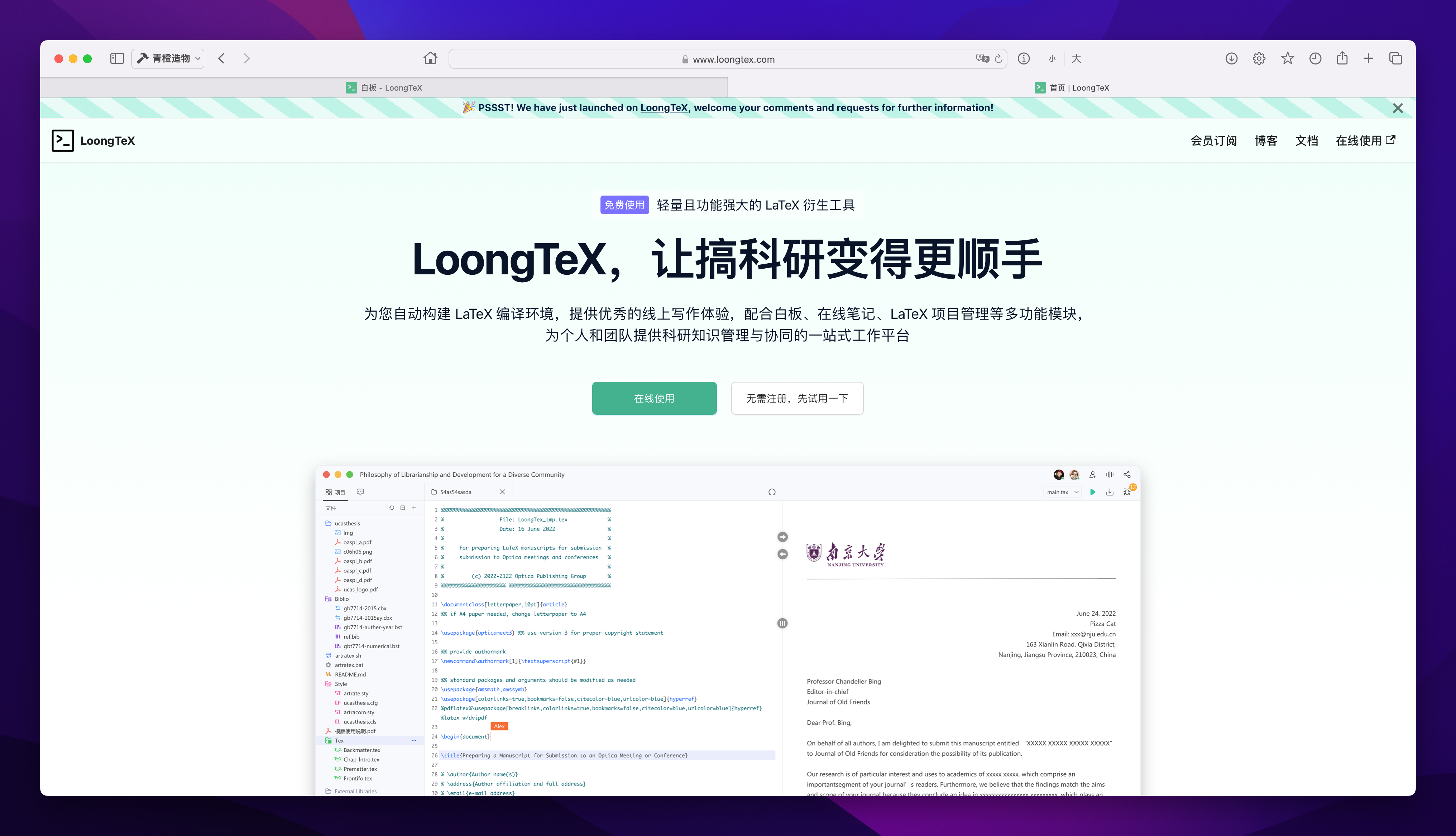
Recently, domestic LaTeX online platform developers contacted me and recommended their newly developed online LaTeX system called LoongTeX.

As a victim of Overleaf connection interruptions, I have been using this new platform for writing papers and notes recently. Also, considering that in the comments section of a path integral introductory article I wrote on Zhihu, some friends hoped I could organize the content into a document, I took this opportunity to rewrite this article using LoongTeX and placed it in the template library. The PDF document of the path integral introductory guide is available on Baidu Netdisk for friends who need it:

Link: https://pan.baidu.com/s/1z2imI8CTTk9dX6pO1chHFw?pwd=amit

Next, I'll briefly share the good aspects I've experienced and the areas that still need improvement.

LoongTeX Official Website

1. Good Attention to Detail

First and most importantly, it finally doesn't lag anymore. I haven't encountered any connection interruption issues during my writing, while Overleaf's connection interruptions can really drive people crazy when severe.

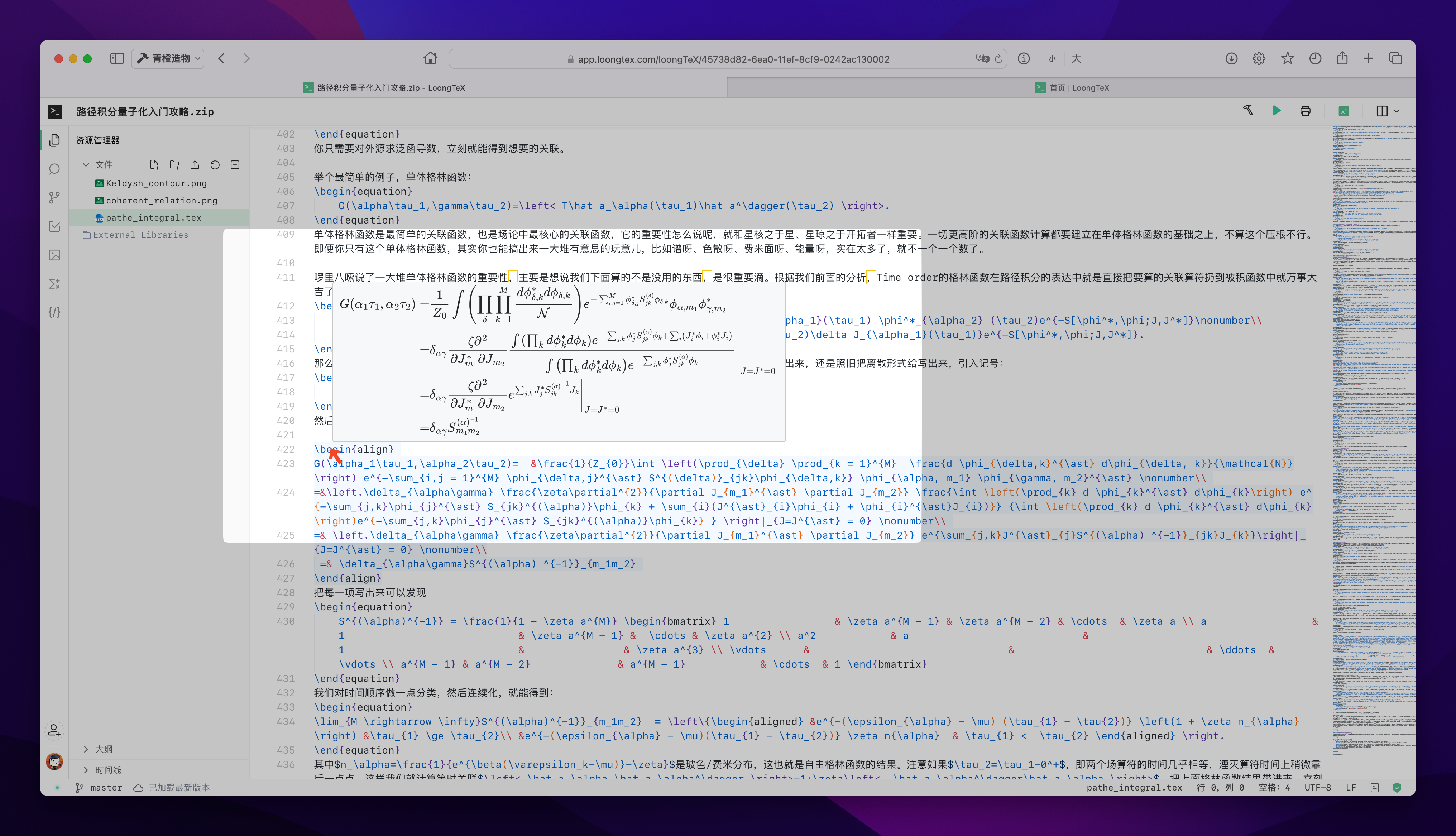
Compared to Overleaf's separation of LaTeX code area and compilation results, what I personally find better about LoongTeX is that when I move the mouse to the formula code position (at \begin{equation}) after typing a formula, the formula automatically displays, which can be considered a form of WYSIWYG (What You See Is What You Get).

Formula Preview

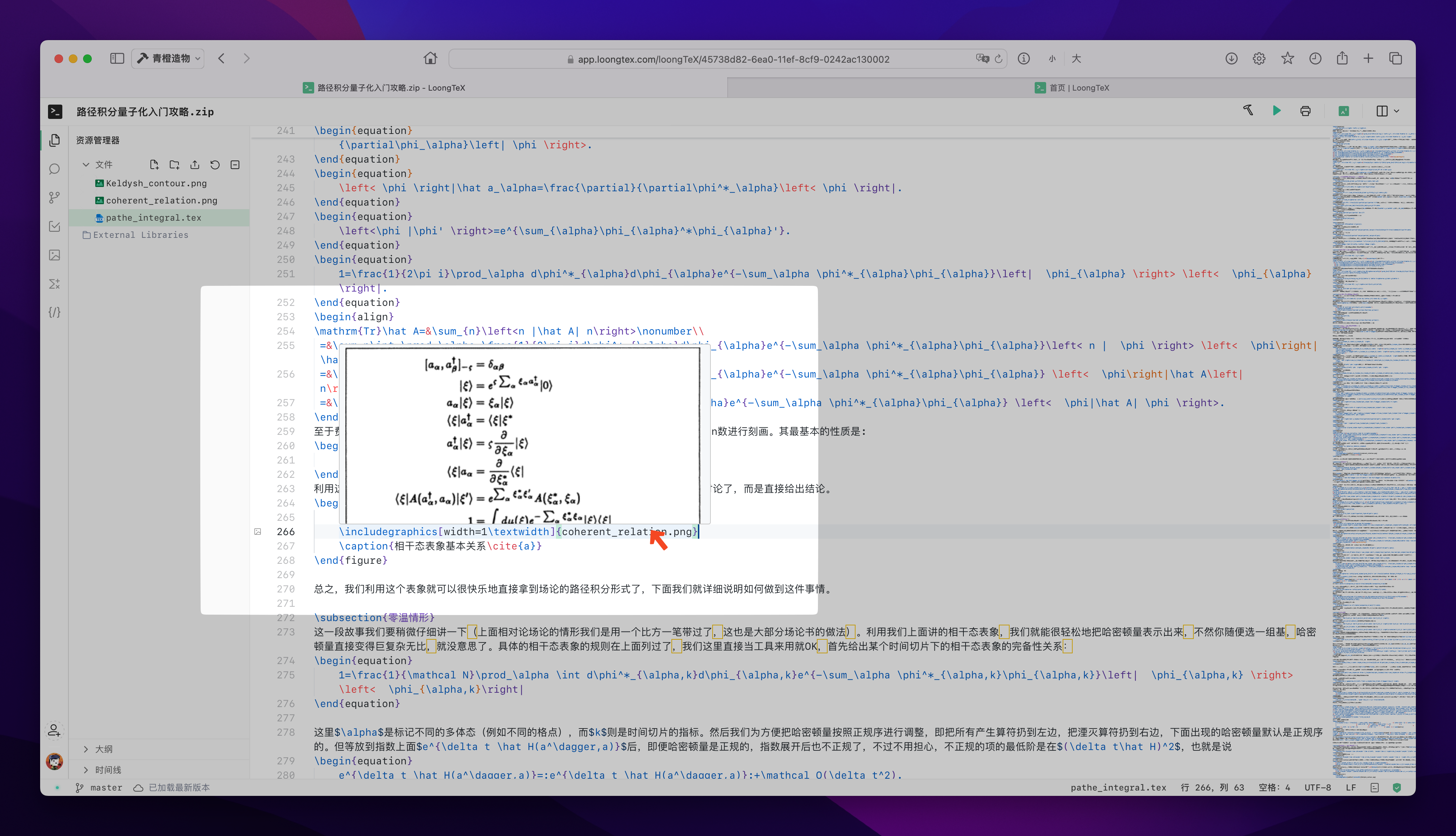
Additionally, when you move the mouse to image code (i.e., \begin{picture}), the system also shows which image is imported here, which looks quite good. However, this feature is still under development and improvement, looking forward to the complete version.

Image Preview

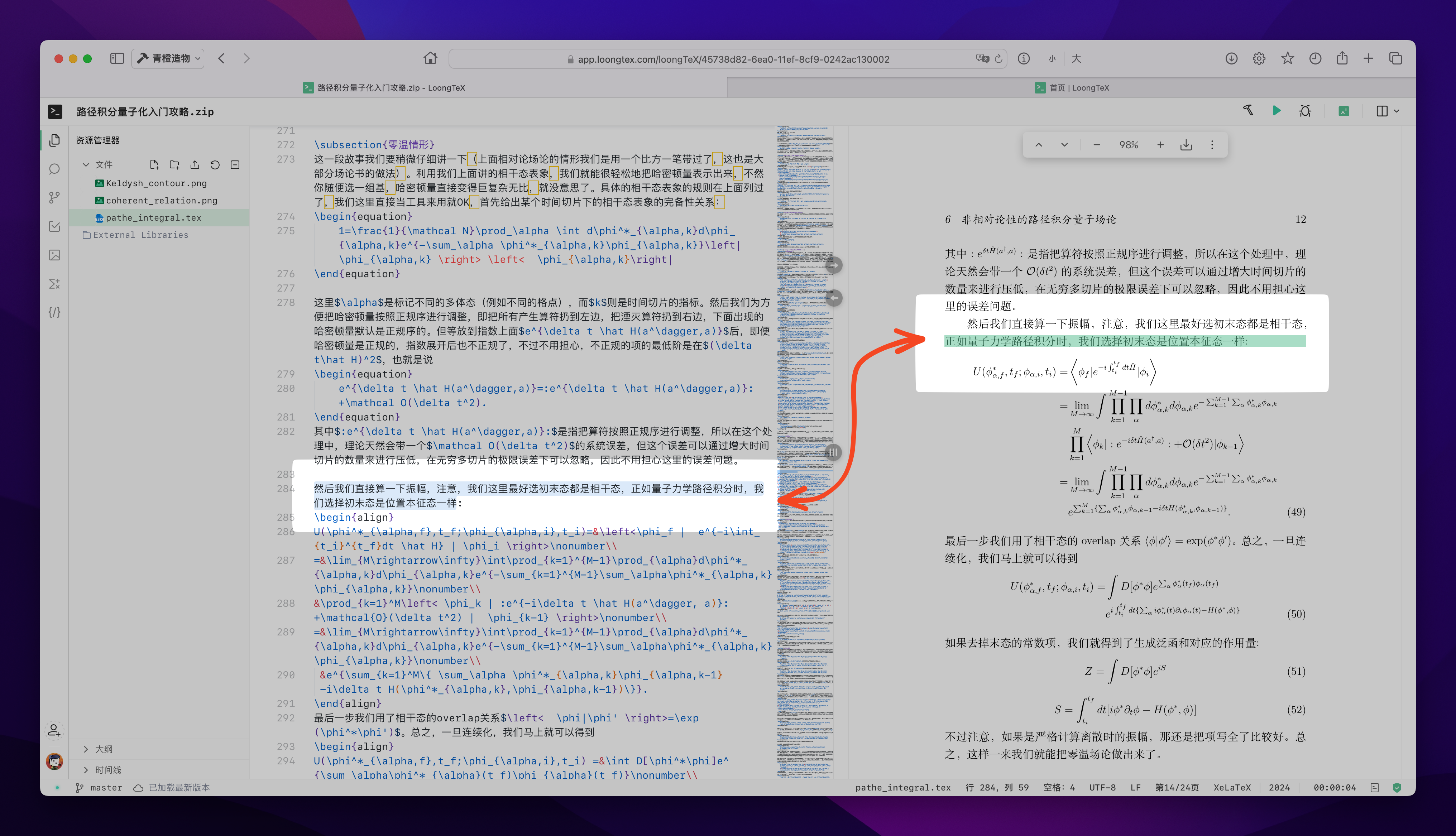
Furthermore, when we double-click to select a certain piece of text or code in the LaTeX editing area, the PDF document not only jumps to the corresponding page like Overleaf but also temporarily highlights the specific position in the PDF to indicate the exact location, which is indeed more convenient.

Mapping Jump

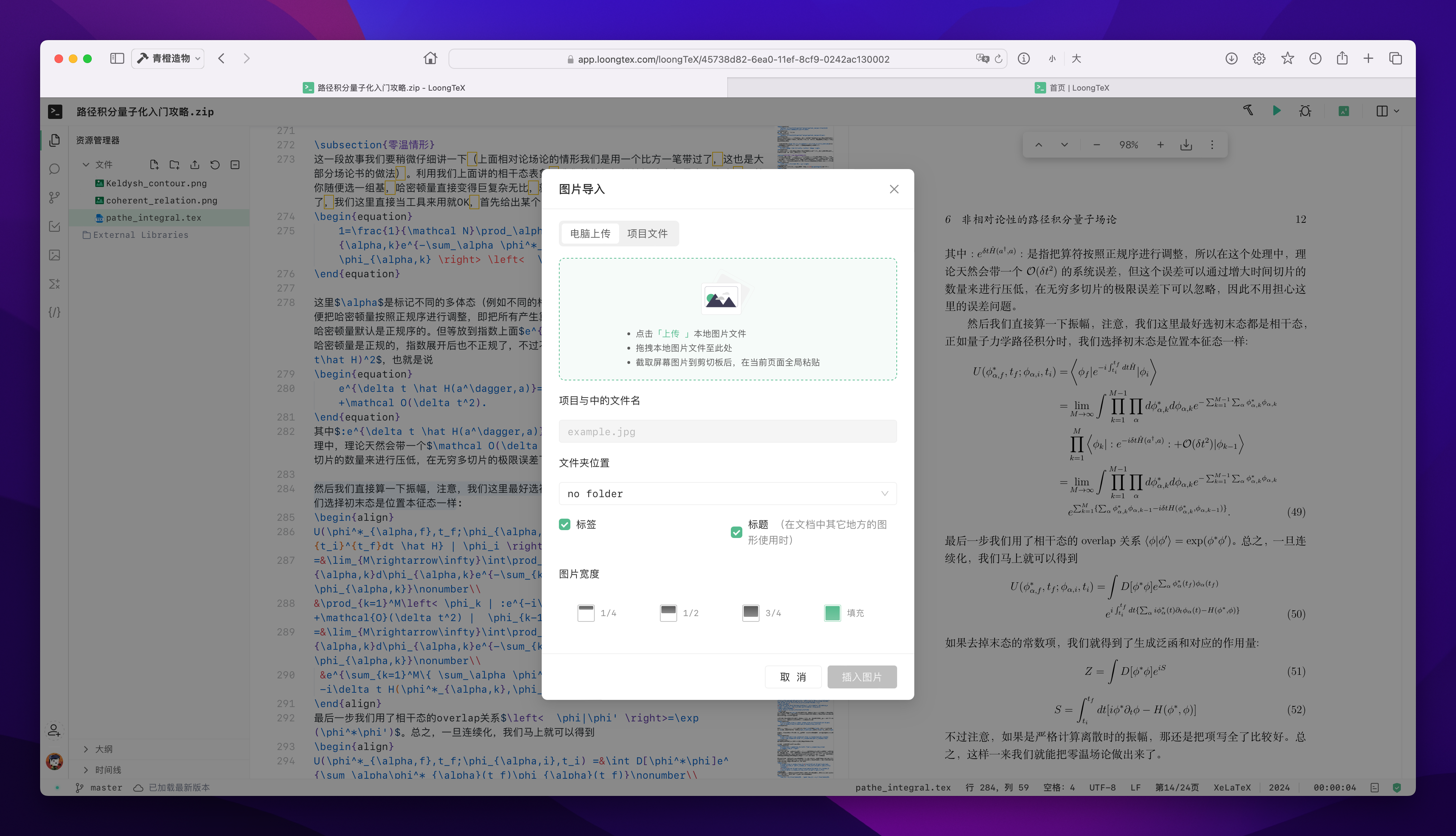
Regarding image import, you can even directly paste screenshots, unlike Overleaf where you need to download first and then import. Sometimes when writing Notes, casually taking screenshots and putting them in notes better matches most people's work habits.

Import Image

As for other aspects, I don't have many feelings. Objectively speaking, what makes a noticeable impression is either having obvious advantages compared to other products or having obvious disadvantages compared to other products. Overall, it feels quite smooth and comfortable to use.

2. AI Integration

A common problem beginners encounter when writing LaTeX is that the system reports an error, and then we don't know how to handle it, so we need to search everywhere and ask questions. What's quite amazing about LoongTeX is that they have integrated AI to solve this problem (and of course, you can also have direct AI conversations).

During my use over the past few days, I encountered a small issue when importing images, using the following code:

\begin{picture}
\centering
\includegraphics{coherent_relation.png}
\caption{Coherent State Basic Relationship\cite{a}}
\end{picture}

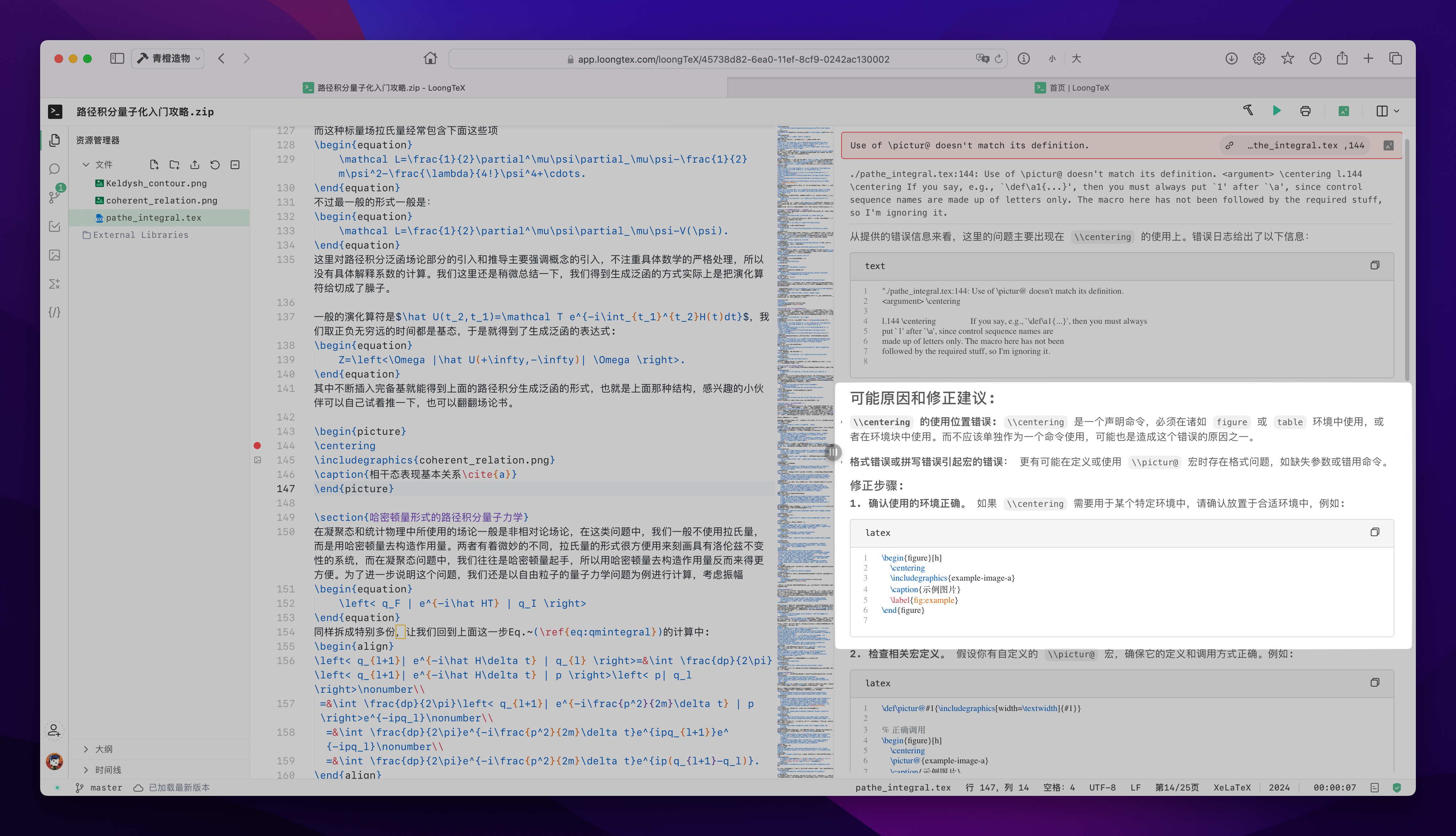
The imported images ended up crooked and of incorrect size. When checking the error information, I unexpectedly found that clicking on the error information would bring up AI to explain the log, and it even provided modified code at the end. When I used the AI-modified code, the problem was directly solved. I think this experience is quite impressive. In fact, many of these good designs weren't even told to me by the developers - they just recommended I try it, and I encountered quite a few pleasant surprises.

AI Error Prompt

\begin{figure}[h!]
\centering
\includegraphics[width=1\textwidth]{coherent_relation.png}
\caption{Coherent State Basic Relationship\cite{a}}
\end{figure}

In addition, there's also an independent AI conversation interface available in the sidebar, which is very convenient. By the way, regarding AI risk issues, I also consulted the development team. The AI does not capture our written content; the information input to AI is only what we enter in the AI interface, so there's no need to worry.

3. Price

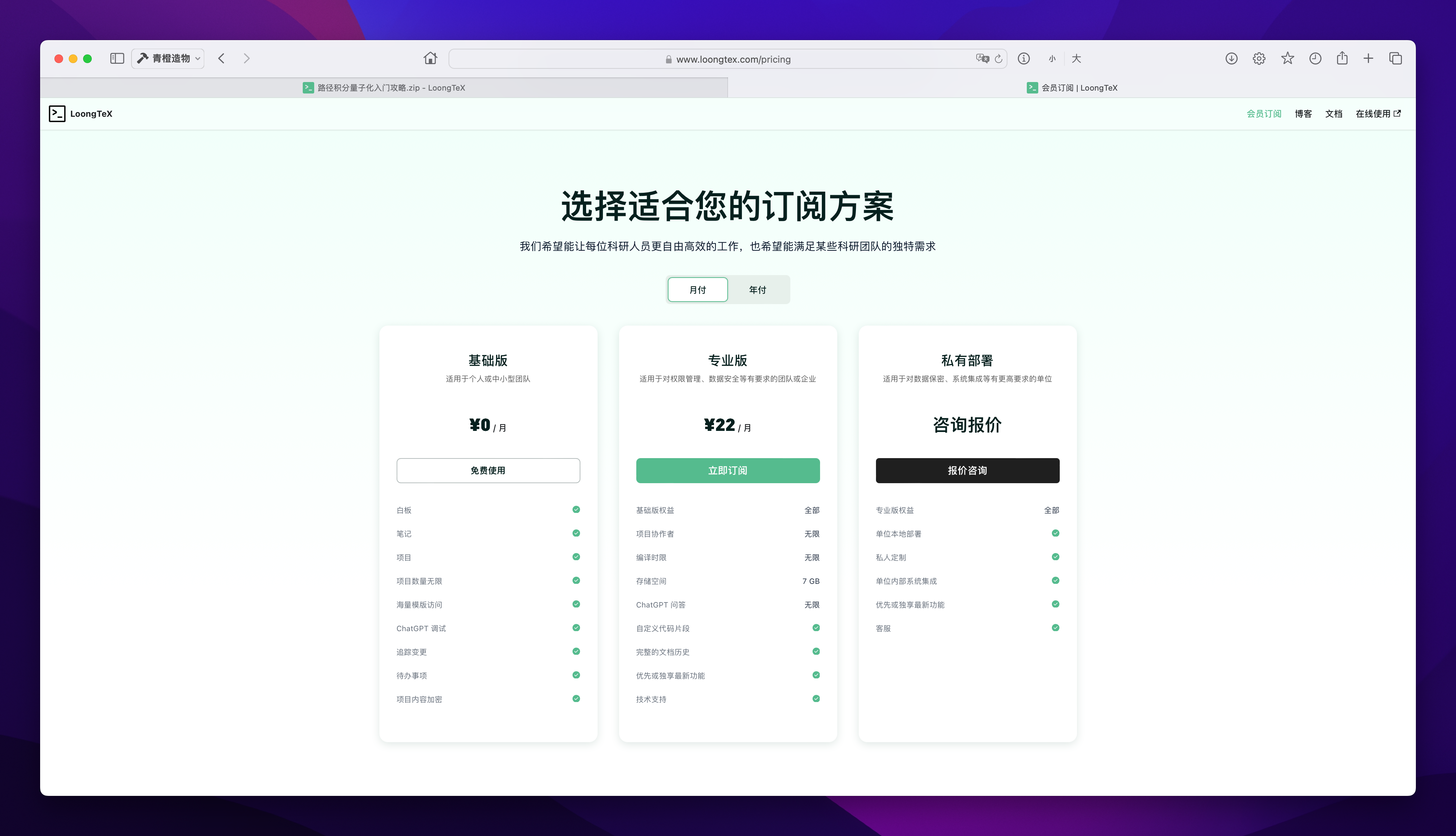
It must be said that domestic products generally excel in terms of cost-effectiveness. There's only one tier for the paid version: monthly payment of 22 RMB, annual fee of 233 RMB (monthly average 19.4), which is cheaper than subscribing to a video streaming service (complaining that video streaming services are getting more expensive these days, and there are separate TV memberships for televisions, plus advanced viewing options).

After subscribing to the membership, what I personally find most useful is unlimited remote collaboration. Other features are various enhanced packages, which I haven't experienced much, so I won't elaborate.

Membership Subscription

4. Areas Needing Optimization and Development

Actually, when I first started using it, I asked the development team if they planned to implement a feature similar to Overleaf's visual editor, since visual editing is also an important need in our daily use. They told me they wouldn't, which is slightly regrettable. However, correspondingly, they plan to implement Markdown support later. Since I use Markdown more often for writing notes, I'm looking forward to this and hope it can be released soon.

Currently, the documentation is not rich enough. I also consulted the team about this, and they seem to be frantically supplementing the documentation, even causing occasional 403 errors on the homepage due to too frequent updates (though the editing page has no issues at all). I can't help but mourn for their hair.

Additionally, compared to the well-established Overleaf that can directly submit papers to arXiv and some journals (though I haven't used this feature), LoongTeX still has a long way to go. However, it seems that projects can already be directly saved to one's own GitHub account, which is a good feature.

Furthermore, features for project sharing and setting one's own projects as public templates are still under development. I hope these can be implemented quickly. I originally wanted to directly share the project on Zhihu, but unfortunately, it's not possible yet.

5. Summary

Overall, I personally think LoongTeX is a quite excellent platform, rated as an online LaTeX editing platform more suitable for the Chinese user experience. Just the absence of connection interruption issues alone gives me enough reason to move some of my work to this platform. As for the various other small details, once you get used to them, you really can't go back. So I recommend friends like me who usually need to use LaTeX for work but aren't highly skilled in LaTeX technology to use it (especially friends suffering from Overleaf connection interruption issues). Of course, highly skilled students can also refer to it to enhance their configurations. In short, I hope domestic LaTeX platforms can develop better and better.


LoongTeX —— Making Research Happen Better
FOR TRUTH AND BEAUTY

New Feature〔 TODO List 〕

· 2 min read
Wukong
Maintainer of LoongTeX

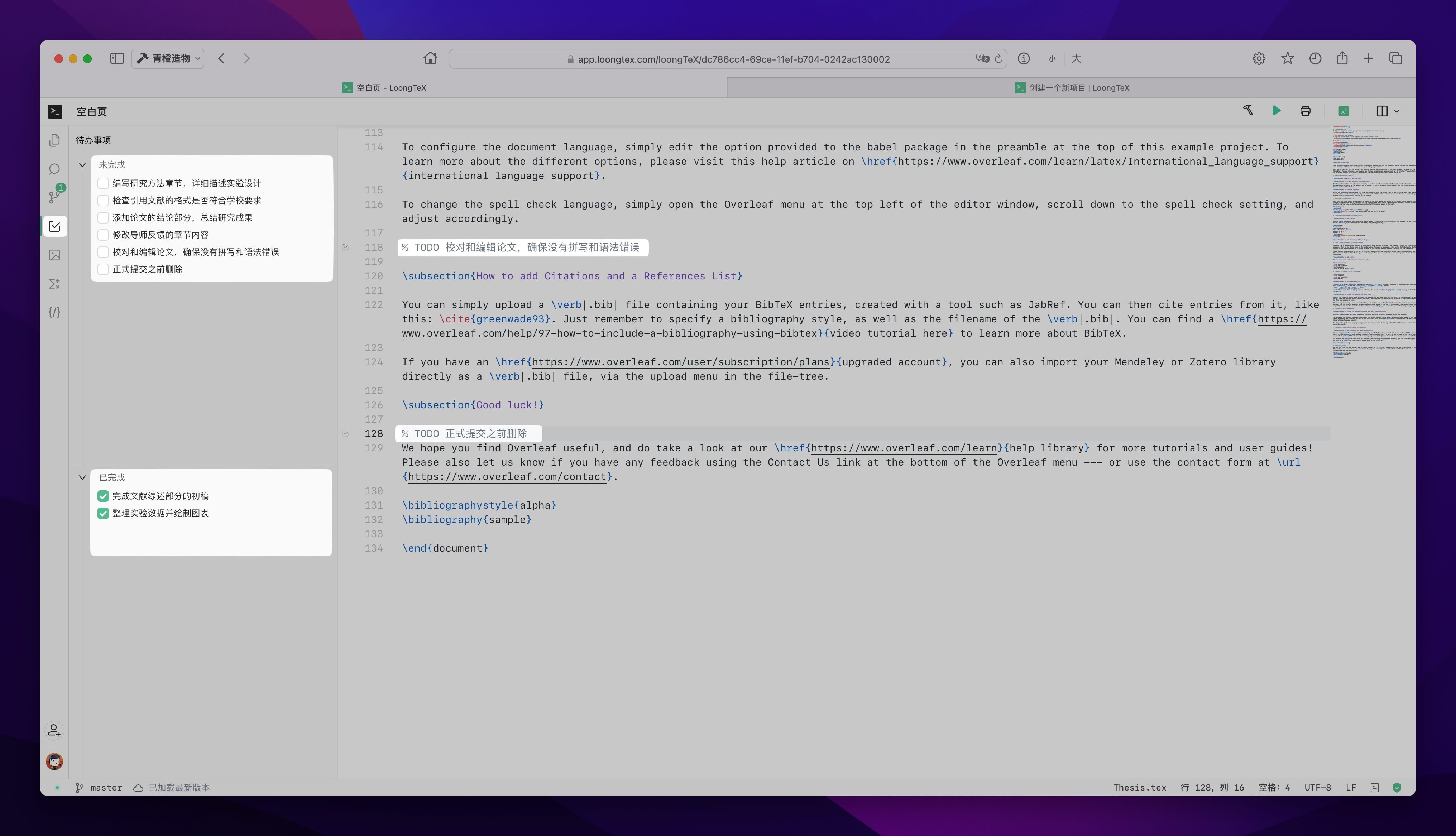
In scientific research work, reasonable task management and clear organization of ideas are crucial for improving work efficiency. To this end, LoongTeX has added a convenient TODO list feature that allows users to add and manage TODO items directly in project files, helping researchers better organize and plan their work.

Download project file in editor

Feature Overview

LoongTeX's TODO list feature allows users to add TODO items anywhere in project files by simply using a specific comment format. TODO items are automatically recognized and recorded by the system, and are centrally displayed in the project for easy viewing and management.

Usage Rules

To create a TODO item in LoongTeX, simply add a comment line in the project file following this format:

% TODO My TODO item
  • Format Requirements: The TODO format must start with % TODO, followed by the TODO content.
  • Case Sensitive: Must strictly use uppercase TODO. Lowercase or mixed-case todo will not be recognized.
  • Any Location: TODO items can be added anywhere in the project file. LoongTeX will automatically scan the entire file and recognize all TODO items.

Feature Highlights

  1. Automatic Recognition and Management: LoongTeX automatically recognizes TODO items in project files and displays them centrally in a separate TODO panel.
  2. Real-time Synchronization: After adding or modifying TODO items, the system updates in real-time, ensuring users can always view the latest TODO status.
  3. Intuitive and Simple: No additional plugins or complex operations are required. Just a simple comment line can create a TODO item, making it very convenient and quick.
  4. Collaboration Support: In multi-person collaborative projects, all members can see and manage TODO items in the project, facilitating team task allocation and progress tracking.

Application Scenarios

  • Task Breakdown: Break down complex research tasks into multiple small TODO items and complete them step by step.
  • Team Collaboration: Clarify tasks and responsibilities for each member in team projects.
  • Work Planning: Create daily or weekly work plans to improve work efficiency.

Summary

LoongTeX's TODO list feature aims to simplify the task management process for researchers, helping users manage and complete work tasks more efficiently. By using a simple comment format to create TODO items, efficient and convenient task management is achieved. LoongTeX is committed to providing researchers with a more user-friendly and efficient writing and collaboration experience.


LoongTeX —— Making Research Happen Better
FOR TRUTH AND BEAUTY

A Brand New Self-Developed LaTeX Research Platform

· 12 min read
Wukong
Maintainer of LoongTeX

It is not a master, but a servant. It doesn't roar, nor show off. It appears when you need it, and fades away when you focus. It is the ideal state of tools in our minds.

Prologue: Where Does Researchers' Time Actually Go?

Have you ever had moments like these:

  • Exporting literature from Zotero to Word, then copying from Word back to LaTeX—just the word "transportation" makes you waste an entire afternoon.
  • To change the reference format of a manuscript, you open three documents, two web pages, five tabs, and end up manually editing each entry one by one.
  • Repeatedly confirming document versions with supervisors and collaborators, even after sending v3_final_final_last_but_really_final.tex, you still miss the most critical comments.
  • Wanting to organize thoughts and write a framework, you switch between whiteboard tools, mind mapping tools, note-taking tools, and then back to writing tools—writing wherever you can, and giving up if you can't find something.

These moments are maddening.

What's even more maddening is: We've long grown accustomed to this pain.

As if doing research should come with an "anti-human toolchain"; As if engaging in academia cannot have efficiency and aesthetics.

But have you ever thought— If we bring writing, note-taking, collaboration, typesetting, and sharing all into one platform, If this platform understands researchers, understands LaTeX, and also understands AI, what would that look like?

Frankly Speaking

We certainly understand that most researchers' time isn't actually wasted on real "research."

More often, you're dealing with endless group meetings, presentations, review processes, and those meetings that may or may not be meaningful but you must attend. Plus a bunch of administrative tasks—filling forms, stamping seals, following procedures—the absurdity of it all makes it hard not to sigh, even if you don't want to complain.

Frankly speaking, we can't solve these problems. We don't have the authority, nor the power.

We make tools, not institutional reforms.

But the good news is: These "structural problems" are indeed gradually improving—from administrators to students, everyone is beginning to realize: if we keep consuming time like this, research will only become more like a job.

So we can only start from what we can do, from the small entry point of "research tools," trying to reclaim a bit of your precious time and attention.

We know this might not change what time you can leave work today, but it can determine whether you'll stay up until 3 AM tonight for a PPT or a submission format.

We can't make you attend fewer meetings, but we can make you take fewer detours when you're actually writing.

This is what we can do, and what we want to do.

The Current State of LaTeX Tools:

Retro Interface

Some tools, the moment you open the page, make you feel like you've time-traveled back to an IT classroom from last century.

Menu bars are densely packed, buttons look like Excel's nephew or Photoshop's distant relative. Even just adding an image or inserting a formula requires three or four clicks and switching between several panels.

Interaction Design is Extremely Primitive:

  • Dragging is unresponsive, with delayed reactions;
  • Page flickering, font aliasing;
  • Icons look like CD-ROM UI templates from a 1998 Zhongguancun training course.

With this kind of experience, they still dare to charge. The key is they don't even think there's a problem—as if researchers should endure the fate of "crude tools," even feeling somewhat smug: "This is the geek style."

Sorry, it's 2025 now, we're not playing command-line aesthetics, we just want to write an article efficiently.

Barren Community

While using it, you find some feature isn't working well, so you kindly make a suggestion, imagining the product manager enthusiastically responding: "Thank you for your feedback, we'll add it in the next version."

But reality is: 👻 No one replies. 👻 GitHub issues go unanswered for half a year. 👻 Finally, someone pops up with one sentence: "Welcome PR or fork."

You're not a community developer, you're an ordinary user, buddy! I came here to write papers, not to be a volunteer for tool secondary development!

What's even more outrageous is: many tools don't even have clear teams, you don't know who's maintaining them or whether they'll crash next month, the entire ecosystem seems to run on love and passion.

Fragmented Tools

The research process should be smooth, like a production assembly line, where ideas flow seamlessly.

But reality is: We're forced to "hurdle jump" between seven or eight different tools:

  • Writing with LaTeX editor
  • Drawing requires switching back to Matplotlib, Origin, or PGFPlots
  • Reading literature with Zotero, but notes are taken in Notion
  • Document collaboration relies on WeChat + email repeatedly sending files
  • Making slides requires returning to PowerPoint, plus screenshotting, pasting images, manually adjusting formats

This isn't called research, this is called "Research Physical Obstacle Course." Every time you switch platforms, your brain has to reboot. By the end of the day, you're not worn out by your research topic—you're broken by the tools.

What's even worse—these tools don't know each other at all. Things like bidirectional linking, citations, synchronization—all rely on your manual labor.

And as long as one of these tools crashes, disconnects, or won't open—the entire process breaks down. Research成果 get stuck between tools, unable to move.

Expensive Yet Hard to Use

The most bizarre thing about the research tool circle is: Outrageously expensive, yet made like amateurs.

Many tools boast "premium accounts," "team collaboration versions," "unlimited projects," with annual fees ranging from several hundred to thousands. You think upgrading will unlock heaven, but you discover:

  • Collaboration features are just shared links, no permission management, no commenting mechanism, even synchronization has delays
  • Premium templates are just a few more variations of \maketitle covers
  • Servers crash when busy, even PDF compilation can fail for an entire afternoon
  • Might as well install TeXLive locally for compilation—at least it's stable

What's even more ridiculous: if you don't pay, there are tons of restrictions; if you do pay, the service quality doesn't improve, the only thing that becomes "premium" is your bill.

With this kind of experience, do they have the face to wave the banner of "serving researchers"? We're not demanding perfection, we just hope the money we spend can buy real efficiency and respect.

If all this sounds familiar to you, congratulations—you're not alone sinking in the quagmire of research tools.

But don't lose heart, what we're about to introduce next is—a completely new species that breaks these bizarre现状: LoongTeX.

A research platform that no longer makes you "endure using it," but truly lets you enjoy using it.

Finally, Someone is Taking Charge

In 2025, we decided to step up and do something different:

Not adding a web shell to LaTeX, not changing the skin and re-releasing Notion's wheel, We want to completely reinvent the research writing process.

Thus, LoongTeX was born.

It's not another "usable" LaTeX editor, but a future-oriented research productivity platform.

What Can LoongTeX Do?

Connecting the Research Process from Notes to Submission

Writing a paper isn't a one-time deal; it's a process of repeated experimentation,推翻, reconstruction, and organization LoongTeX lets you go from outlining, drawing diagrams, recording inspiration, to generating PDFs and submitting—all in one stop

  • Write documents: Online LaTeX editing, no installation required, WYSIWYG
  • Take notes: Strongly bound to documents, supports bidirectional linking, AI automatic categorization
  • Insert charts/tables: Built-in TikZ, pgfplots drawing support, can even call APIs for drawing
  • Read literature: Integrated literature database synchronization, notes automatically linked to BibTeX
  • Export/share: PDF, HTML, Markdown, Zhihu, one-click distribution

Four Smart Tools, Efficiency Directly Increases by 300%

We carefully studied the entire writing path of researchers, from project initiation, to topic establishment, literature review, framework listing, first draft writing, format adjustment, illustration creation, proofreading, submission, revision, more revision, resubmission—the whole journey resembles "fighting monsters to clear levels."

So we asked ourselves: If the entire research process is like a battle, can LoongTeX be like an equipment system, providing you with weapons, armor, skill books, and health packs?

The answer is: Yes, and right now.

Smart Notes —— Automatically turning your fragments into systematic knowledge assets

What do researchers fear most? Not having insufficient materials, but having information that's too fragmented.

You see an inspiration on WeChat, mark an abstract in Zotero, write two lines of comments in Word, then look back—none of them are in the same place, none can be retrieved.

LoongTeX's smart note system is your central nervous system for the research world:

  • Citing literature? Automatically links to BibTeX entries
  • Transcribing paragraphs? Automatically extracts citation page numbers + tags
  • Writing notes? Automatically identifies topics, keywords, research directions
  • Want to review? Bidirectional linking, notes interconnected with each other, understanding you better than you understand yourself

Every piece of text you write, even just a sentence like "Don't delete this yet, might be useful," it can remember, categorize, and archive.

Fragmented records will eventually precipitate into your academic knowledge graph.

Inspiration Whiteboard —— From "unclear thinking" to "clear at a glance," just one diagram away

Have you thought about it? Our brains aren't actually good at writing a paper in one go. What we're good at is: first listing points, then connecting them into lines, finally weaving them into a network.

LoongTeX's inspiration whiteboard is the tool that graphically visualizes this process with one click.

Just write a few keywords, and it can:

  • Automatically generate structure trees or mind maps
  • Organize logical relationships by chapters, helping you sort out a "writable" path
  • Supports drag-and-drop sorting, node folding, color marking, like using Miro but optimized for research
  • Even better: When you modify structure on the whiteboard, the main text automatically synchronizes and updates the outline

No longer just a lonely "project flowchart" page on PPT, but a truly embedded thinking topological network in the writing system.

This isn't a whiteboard tool, this is researchers' "strategic map".

AI Assistant —— A 24-hour non-tiring paper collaborator

Don't be fooled by the name, "AI Assistant" isn't a useless ChatGPT popup.

In LoongTeX, it's a well-trained, deeply customized, context-aware research-specific intelligent partner:

  • Want to polish sentences? Select → Right-click → One-click academic rewriting, clear, formal, logical
  • Want to supplement references? AI directly judges from context which paper you're talking about, automatically adds BibTeX
  • Want to quickly outline? Write a sentence like "Research trends of XX in XX aspects," it can expand into 5 structural suggestions
  • Want to conduct knowledge research? It can organize and compare core literature, mainstream views, controversy焦点 from the past 5 years on your topic

What makes it smarter than ordinary AI is: It's not just a "general language model," but a research model deeply customized for research scenarios.

You can understand it as: A collaborator who never gets tired, never gets annoyed, always online, it doesn't compete for authorship, but can help you write better, faster, more accurately.

Unified Platform —— Stop running your legs off between 10 Apps

This last tool might seem unremarkable, but its efficiency improvement is transformative:

One platform, eliminating 10 Apps for you.

  • Writing: LaTeX / Markdown / Rich text, choose freely
  • Drawing: Built-in TikZ/pgfplots drawer, can also call APIs for data visualization
  • Citation management: Automatically syncs with Zotero, what you see is what you cite
  • Project collaboration: Document sharing + role permissions + discussion comments + Git version backtracking
  • Thinking structure: Embedded mind maps, knowledge graphs, chapter restructuring tools
  • Export/share: One-click conversion to PDF / HTML / Markdown / online links / WeChat public account articles

You no longer need to:

  • "Screenshot and paste into PPT"
  • "Copy Notion notes back into paper text"
  • "Discuss LaTeX formula typesetting using WeChat"
  • "Email files back and forth, making errors in transmission"

With LoongTeX in hand, from project initiation to submission to promotion, the entire process is seamlessly connected.

These four smart tools are not flashy "AI skins", nor are they "patches for traditional tools."

They are products of us standing from the perspective of "research practitioners," redefining research workflows from 0 to 1.

You no longer need to struggle with tools, you only need to focus on: Your ideas, your expression, your成果.

Real Multi-person Collaboration, Not "Fake Synchronization"

  • Real-time collaboration: You write formulas, they polish paragraphs, literature同步 updates, zero delay
  • Version management: Automatic saving, historical backtracking, comparison highlighting, supports Git integration
  • Permission control: Supervisors, collaborators, submission targets—all can have customized permissions
  • Comment system: Highlighted comments, discussion areas, notification tracking,不怕 information being淹没

Reconstructing Research Work Methods

LoongTeX isn't just a writing platform, it's a research workflow platform:

  • Project-based management: One research topic, from initiation to conclusion, full cycle visualization
  • File structure automation: Chapter management, citation detection, format one-click standardization
  • Supports API calls: Open capabilities for custom scripts, data analysis, AI Agent integration
  • Seamless对接 with tools like Zotero, Overleaf, Typora—not letting existing assets go to waste

Future Feature Preview

We're not just a project, but a complete set of research "infrastructure."

Just like Notion for notes, Figma for design, Obsidian for knowledge networks, LoongTeX wants to become that "foundational platform" in the research circle.

Next, we'll also launch more "research black technology":

  • 📡 「Research Social Circle」 Achievements automatically generate academic homepages, automatically identify keywords, research directions, cited articles, collaboration networks, making your knowledge assets actively "break out of the circle."

  • 🔍 「Research Radar」 Daily推送 of the latest literature, conferences, trends related to your research direction, even predicting possible research gaps and submission windows.

  • 🧩 「Plugin System」 Whatever you want to add, you can install: submission statistics charts, experimental data chart templates, professional terminology libraries, discipline-specific structure suggestions... all will be opened up in the future.

Final Words: Stop Suffering from Tools, Research Should Be More Pure

We created this product not because "we want to make money from researchers" (we know you don't have money), but because we ourselves have experienced countless nights of "document synchronization failures" and "typesetting adjustments driving us to崩溃." We know the despair of "brain online, hands working like laborers" while writing, so we wanted to build a platform that completely eliminates this pain.

LoongTeX, Let Research Writing Return to Its Essence


LoongTeX —— Making Research Happen Better
FOR TRUTH AND BEAUTY